
If you train seriously, you have already been told to get in an ice bath. Probably by a coach, possibly by a teammate, almost certainly by something on your phone. What you were less likely to be told is how cold the water should be, how long to stay in, or the fact that there are sessions after which an ice bath will actively work against you.
Cold-water immersion is one of the better-studied recovery methods in sport, and the research is more specific — and more interesting — than the usual advice suggests. Here is what it supports, and how to turn it into something you can actually use.
Does an ice bath actually help recovery?
For some things, clearly yes.
Across systematic reviews and meta-analyses, cold-water immersion consistently reduces delayed-onset muscle soreness compared with passive rest, with the effect measurable up to 72 hours after hard exercise. It also lowers blood markers associated with muscle damage, such as creatine kinase, in the 24 to 48 hour window.
What it does not reliably do is make you fitter, stronger or faster on its own, and it is not a treatment for an actual injury. If something is torn, strained or swollen in a way that concerns you, that is a conversation with your physiotherapist, not a tub.
It is also worth being honest that a meaningful share of the benefit may be perceptual — athletes feel more recovered. For a professional standard of scepticism that matters. But if you are backing up for a second session in eighteen hours, feeling ready is not a trivial outcome.
How cold should an ice bath be?
Colder is not better, and this is where most people get it wrong.
The research converges on roughly 11°C to 15°C. A network meta-analysis examining different combinations of duration and temperature found that a moderate dose — moderate temperature, moderate time — outperformed both the milder and the more extreme protocols for reducing soreness.
Dropping to 5°C or below does not add benefit in proportion to the discomfort. What it does is shorten how long you can tolerate the water, which pushes you out before you have had a useful exposure, and raises the risk of a cold-shock response. The bravado version of the ice bath is not the effective version.
How long should you stay in?
Ten to fifteen minutes in that 11–15°C range covers most of the benefit. Beyond that the returns flatten out.
One detail that gets ignored: the dose is temperature held over time, not the temperature at the moment you got in. A tub of water and ice starts cold and warms steadily — from the room, and from you. Fifteen minutes that begins at 10°C and drifts to 18°C is not fifteen minutes of cold-water immersion. It is a few minutes of it followed by a cool bath.
The part most serious athletes miss
This is the finding worth changing your routine over.
Repeated cold-water immersion straight after resistance training appears to blunt the adaptations you were training for — attenuating gains in maximal strength, power and muscle hypertrophy. The prevailing explanation is that the inflammatory signalling cold suppresses is part of how muscle remodels and grows. Suppress the signal often enough and you dampen the response.
Endurance adaptations do not appear to be affected in the same way. That distinction is the practical key.
So the rule of thumb is not “ice baths good” or “ice baths bad”. It is:
If the goal of this block is to get bigger or stronger, do not ice straight after the lift. If the goal is to back up a performance — tomorrow’s match, this afternoon’s second session, day three of a tournament — that is when cold earns its place.
So when is an ice bath worth it?
Use it when the priority is availability:
- Congested fixtures — two matches inside a week
- Tournament and festival play, where you compete on consecutive days
- Double sessions, where you train again the same day
- In-season generally, when being available on Saturday matters more than adding a kilo to your squat
- After training in high heat — a South African summer pre-season qualifies
Skip it, or leave several hours, when:
- You have just finished a hypertrophy or max-strength session in an off-season building block
- You are unwell, or managing an injury your practitioner has not cleared for cold
- You have a cardiovascular condition — check first, properly
The hard part is not the cold. It is the dose.
Everything above depends on hitting 11–15°C and holding it for ten to fifteen minutes. With a tub and bags of ice, you are estimating.
Tap water arrives at whatever temperature it arrives at. Ice dumps it well below the useful range. It then climbs for the whole immersion. And if you are running a squad through one tub, the last athlete in is getting a measurably different session from the first — you have no way of knowing whether anyone got the dose you intended.
None of that is an argument against cold. It is an argument against guessing at it.
Ice bath or cooling system: a practical comparison
| Ice bath | Icebein Recovery System | |
|---|---|---|
| Getting cold | Ice sourced and added per session | Chiller cools water to 5°C in about 10 minutes |
| Setting the temperature | Whatever the ice and the room give you | Set on the digital display |
| Holding it | Drifts upward through the session | Circulated continuously at the set temperature |
| Coverage | Wherever the body sits in the water | Legs and glutes, via fitted cooling garments |
| Space needed | Tub, water supply, drainage | Two connected units |
| Next athlete | Refill and re-ice | Reconnect and run |
Ice baths have their place, and plenty of excellent programmes run them well. The question is whether you can deliver the same dose repeatably, to every athlete, on a Tuesday in the rain.
Where Icebein fits
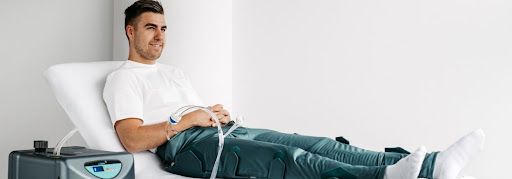
The Icebein Recovery System is a cryo recovery system rather than a tub: a chiller unit connected to cooling garments worn on the legs and glutes. The chiller cools water to 5°C in roughly ten minutes, you set your target temperature on the display, and cooled water circulates continuously through the garments for the whole session.
Practically, that means you can set 12°C, hold 12°C, and give the fourth athlete the same session as the first. No ice run, no tub to fill and drain, no wet room to build.
It is also worth noting that most cold-water immersion protocols in the research immerse the lower body rather than the whole athlete — which is where the load sits for running and field sports anyway.
For schools, clubs and academies putting recovery on their own grounds, Icebein is included in The Pod, our High Performance and Recovery facility. For individuals and single teams, the Icebein Recovery System Starter Kit includes the chiller, one pair of Icebein Legs in your size, a carry bag and disinfectant.
Frequently asked questions
How cold should an ice bath be for recovery?
Around 11°C to 15°C. Research on cold-water immersion dosing finds this moderate range more effective for reducing muscle soreness than colder protocols, which shorten tolerable time without adding benefit.
How long should an athlete stay in an ice bath?
Ten to fifteen minutes within that temperature range. Longer immersions have not been shown to add much, and the temperature needs to hold for the whole duration to count.
Do ice baths stop muscle growth?
Used routinely straight after resistance training, cold-water immersion has been shown to attenuate gains in strength, power and hypertrophy. Endurance adaptations do not appear to be affected the same way. Time it around your training goal rather than avoiding it entirely.
Is a cooling system better than an ice bath?
Both deliver cold. A system like Icebein makes the dose repeatable — you set the temperature and it holds, athlete after athlete — and removes the ice, the tub and the drainage. An ice bath is cheaper to start and harder to control.
Can a whole squad use one system?
Yes. There is no water to refill or re-ice between athletes, so sessions can run back to back at the same set temperature.
The short version
Cold works, for soreness and for backing up performances. Aim for 11–15°C, ten to fifteen minutes, and hold it there. Keep it away from your heavy lifting in a strength block, and lean on it in-season when availability is the priority. And whichever route you take, make sure you are actually delivering the dose you think you are.
Explore the Icebein Recovery System →
References
- Impact of different doses of cold water immersion on recovery from acute exercise-induced muscle damage: a network meta-analysis, Frontiers in Physiology
- Impact of cold-water immersion compared with passive recovery following a single bout of strenuous exercise on athletic performance: a systematic review with meta-analysis, Sports Medicine
- Post-exercise cold water immersion effects on physiological adaptations to resistance training, Frontiers in Sports and Active Living
This article is general information for athletes and coaches, not medical advice. If you are managing an injury or a health condition, speak to your physiotherapist or doctor before starting cold-water recovery.